AI is about tradeoffs. Which ones are we willing to make?
One of the most impactful books I read while I was in college was "Zero to One" by Peter Thiel and Blake Masters.
It's a complicated book for me. I come back to it often, more than a decade after I first read it, even as plenty of what I've seen Thiel do since then hasn't sat well with me.
More with less
One of the ideas explored in the "zero to one" philosophy of innovation defines technology as the ability to do more with less. It's very intuitive: a car takes you further on less effort. Likewise, a spreadsheet crunches through the daily work of an analogue accountant in seconds. There are endless examples.
This principle leads to the very simple intuition that more "technology" is inherently a good optimization to make. Technology lets you do more with less, so better technology then lets you do even more with even less. The meta-cycle continues as we make bigger gains with even higher efficiencies.
"More with less" takes a neutral stance that measures efficiency and not its implications; it is objective about the thing it does with no context on what the gain was for or what it displaced.
Technological fallacy
The biggest problem with "more with less" is that it discounts the cost that is paid for in adopting a new technology, and that can mean a lot of things: job displacement, cultural shifts, and behavioral changes.
With AI, there are a lot of costs that come with adoption—many of which we do not know yet! Job displacement and cultural change are real questions, but they're hard to measure this early.
But behavioral changes are concrete points of evidence we can observe at any time. This has always been true for any new technology: when did we stop memorizing directions and start relying only on GPS? When was the last time you needed to do long division by hand? How has your average step count changed (most likely, a decrease) over time with access to more convenient services via smartphone?
These are all trades most of us made without noticing, and that we were all too happy to make!
AI brings with it dramatic innovation and disruption, and naturally with that comes adoption costs at a brand new scale. AI can write social media posts, books, articles, essays, anything you can add your name to. It's convenient, but with it we pay a cost of the thinking that writing used to force on us.
So yes, AI does let us do more with less. An unprecedented amount of "more". And that "more" is only getting bigger and bigger. But it will continue to come with costs depending on what we point it at.
Choosing our tradeoffs
The responsible take then is to be aware of the costs that you are paying, and that you're okay with that tradeoff. As a software engineer, I accept that I will use AI and trade away the mechanical skill of writing code, but I do not go as far as the judgement or authorship of my software.
This extends beyond just software. I am not willing to pay the cost of losing ownership and direction of the very thing that holds my name, especially my own writing. I'm happy to let AI review my writing and serve as an editor, but I am not willing to pay the cost to have it generate any writing in my name.
Everyone has a different answer, and that's okay. What matters is that each person goes into their AI adoption fully aware of their tradeoff. There has never been another technology as important as this one for us to remember the costs.
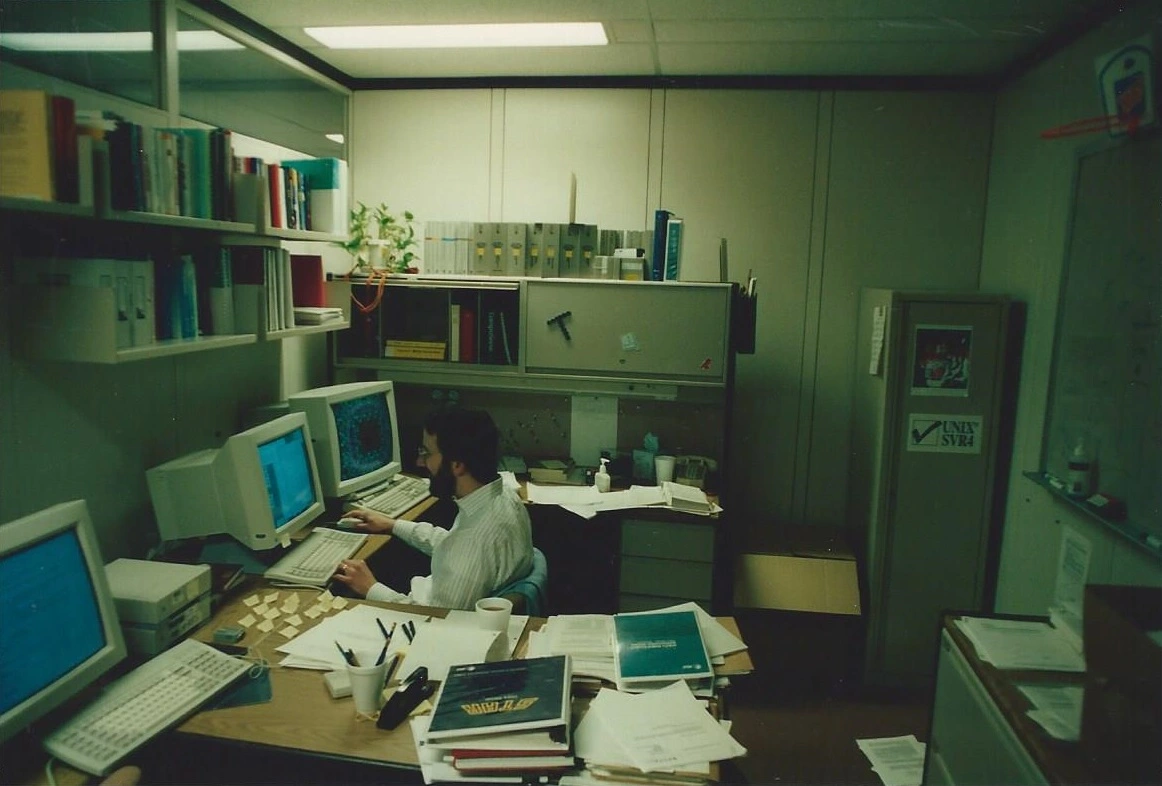
Header photo: "Office within the Unix System Laboratories building in Summit, New Jersey, March 1994" by Jonathan Schilling, licensed under CC BY-SA 4.0. Converted to WebP.
